The Arbitrage Equation
Every card in this list follows the same formula. Buy raw, send to PSA, sell the slab. The math is simple:
Net Profit = (PSA 10 Market Price × 0.8675) − (Raw Price + Grading Fee + Shipping + Insurance + eBay Final Value Fee)
We use 0.8675 as the sell multiplier (eBay takes 13.25%). Grading costs assume PSA Regular service ($150), $10 shipping, $24.99 insurance, and $15 return shipping. These are real numbers from real sales — pulled directly from the KLLKT Command Center database.
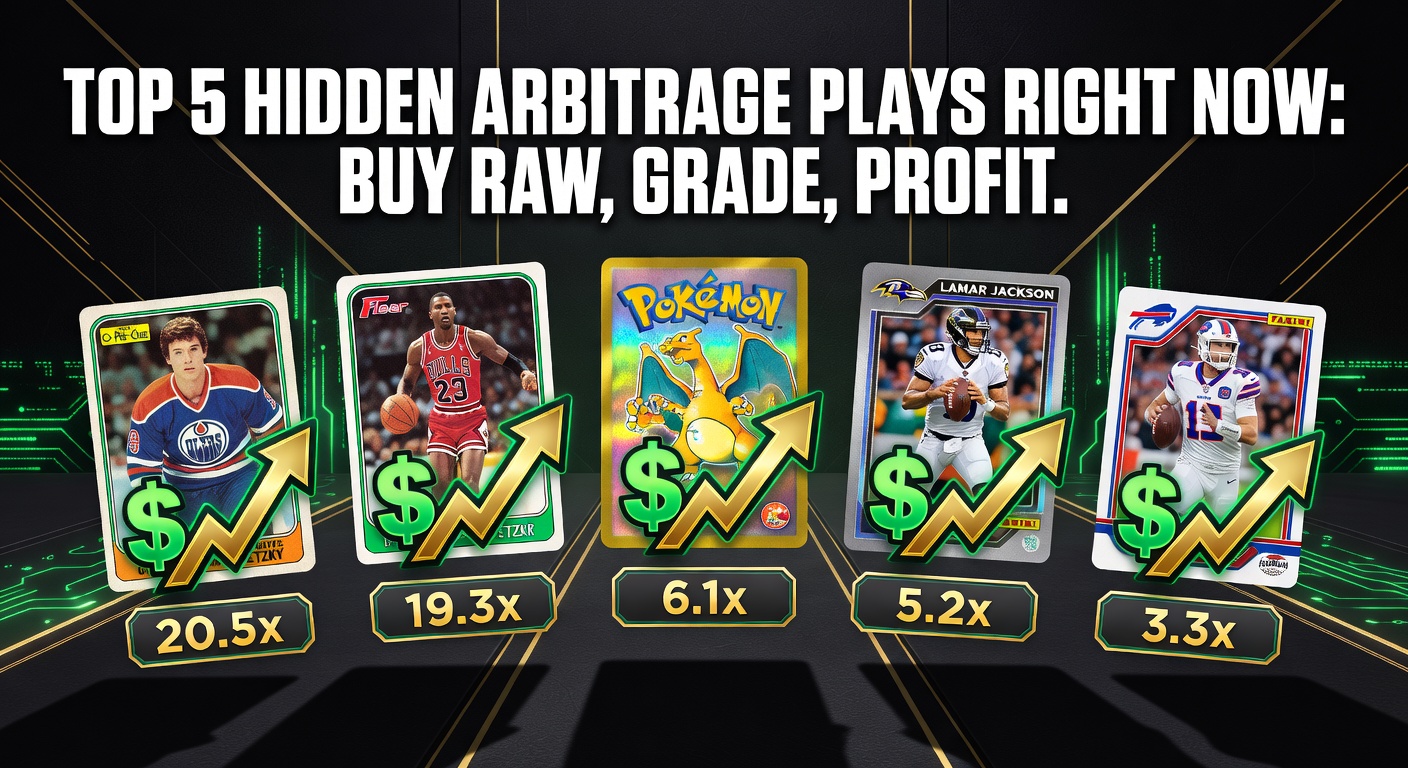
1. Lamar Jackson — 2018 Prizm Silver (20.5x Multiplier)
This is the single best entry point in the entire database right now.
| Metric | Value |
|---|---|
| Raw Market Price | $32.00 |
| PSA 10 Market Price | $655.83 |
| PSA 10 Pop | 890 |
| Net Profit (if PSA 10) | $336.94 |
| Multiplier | 20.5x |
Arbitrage Equation: ($655.83 × 0.8675) − ($32 + $150 + $10 + $24.99 + $15) = $336.94 profit
Why it works: Lamar just won MVP again. The raw market hasn't caught up to the graded market. A $32 entry point with $337 upside is the definition of asymmetric risk. The PSA 10 pop of 890 means supply is limited enough to hold value. Buy raw copies in VG-NM condition, cherry-pick the best centered ones, and submit.
2. Wayne Gretzky — 1979 O-Pee-Chee RC (19.3x Multiplier)
The holy grail of hockey cards. The math is absurd — but so is the difficulty.
| Metric | Value |
|---|---|
| Raw Market Price | $672.71 |
| PSA 10 Market Price | $12,950.00 |
| PSA 10 Pop | 3 |
| Net Profit (if PSA 10) | $10,361.43 |
| Multiplier | 19.3x |
Arbitrage Equation: ($12,950 × 0.8675) − ($672.71 + $150 + $10 + $24.99 + $15) = $10,361.43 profit
The catch: Only 3 PSA 10s exist in the entire world. The odds of pulling a 10 from a raw copy are astronomically low — the 1979 OPC print quality was inconsistent. But even a PSA 9 at $5,656 nets you $4,584 profit. This is a whale play: high risk, legendary reward.
3. Umbreon Gold Star — 2007 POP Series 5 (6.1x Multiplier)
Pokémon's most iconic modern card. The Gold Star Umbreon commands premium prices across every grade.
| Metric | Value |
|---|---|
| Raw Market Price | $1,521.24 |
| PSA 10 Market Price | $9,262.40 |
| PSA 10 Pop | 45 |
| Net Profit (if PSA 10) | $6,313.90 |
| Multiplier | 6.1x |
Arbitrage Equation: ($9,262.40 × 0.8675) − ($1,521.24 + $150 + $10 + $24.99 + $15) = $6,313.90 profit
Why it works: Umbreon Gold Star is the trophy card of Pokémon collecting. Only 45 PSA 10s exist. The raw-to-graded spread remains wide because raw copies are hard to find in truly mint condition — the holographic surface scratches easily. If you find one with clean surfaces and sharp corners, submit immediately.
4. Michael Jordan — 1986 Fleer RC (3.3x Multiplier)
The most iconic sports card ever made. Still printing money for smart graders.
| Metric | Value |
|---|---|
| Raw Market Price | $3,205.50 |
| PSA 10 Market Price | $10,623.50 |
| PSA 10 Pop | 331 |
| Net Profit (if PSA 10) | $5,810.40 |
| Multiplier | 3.3x |
Arbitrage Equation: ($10,623.50 × 0.8675) − ($3,205.50 + $150 + $10 + $24.99 + $15) = $5,810.40 profit
Why it works: The 1986 Fleer Jordan is a blue-chip asset. It's the Berkshire Hathaway of cards — it doesn't go to zero. With 331 PSA 10s in the pop report, it's achievable but not common. The key: look for raw copies with sharp corners (Fleer's die-cutting was inconsistent) and strong centering. Even a PSA 9 at $8,008 clears $4,403 profit.
5. Charizard Base Set Holo — 1999 (5.2x Multiplier)
The entry-level arbitrage play that everyone overlooks because they think it's played out. It's not.
| Metric | Value |
|---|---|
| Raw Market Price | $320.29 |
| PSA 10 Market Price | $1,666.43 |
| PSA 10 Pop | 312 |
| Net Profit (if PSA 10) | $925.35 |
| Multiplier | 5.2x |
Arbitrage Equation: ($1,666.43 × 0.8675) − ($320.29 + $150 + $10 + $24.99 + $15) = $925.35 profit
Why it works: Base Set Charizards are everywhere — but PSA 10 copies aren't. Only 312 exist. The holographic bleed and surface scratching on Base Set cards makes 10s genuinely rare. Buy raw NM copies at $320, inspect under bright light for surface issues, and submit the clean ones. Nearly $1K profit per successful slab.
The Bottom Line
These aren't hypothetical plays. Every number comes from live market data in the KLLKT Command Center. The arbitrage window exists because most collectors don't run the math — they buy slabs at retail instead of buying raw and grading themselves.
Use KLLKT's ScoutBot to track raw prices on these cards. Set alerts for price dips. When a raw copy appears below our listed price, that's your entry. Grade it. Sell the slab. Repeat.
Data sourced from KLLKT Command Center as of March 29, 2026. Prices fluctuate daily. Always verify current market prices before purchasing.