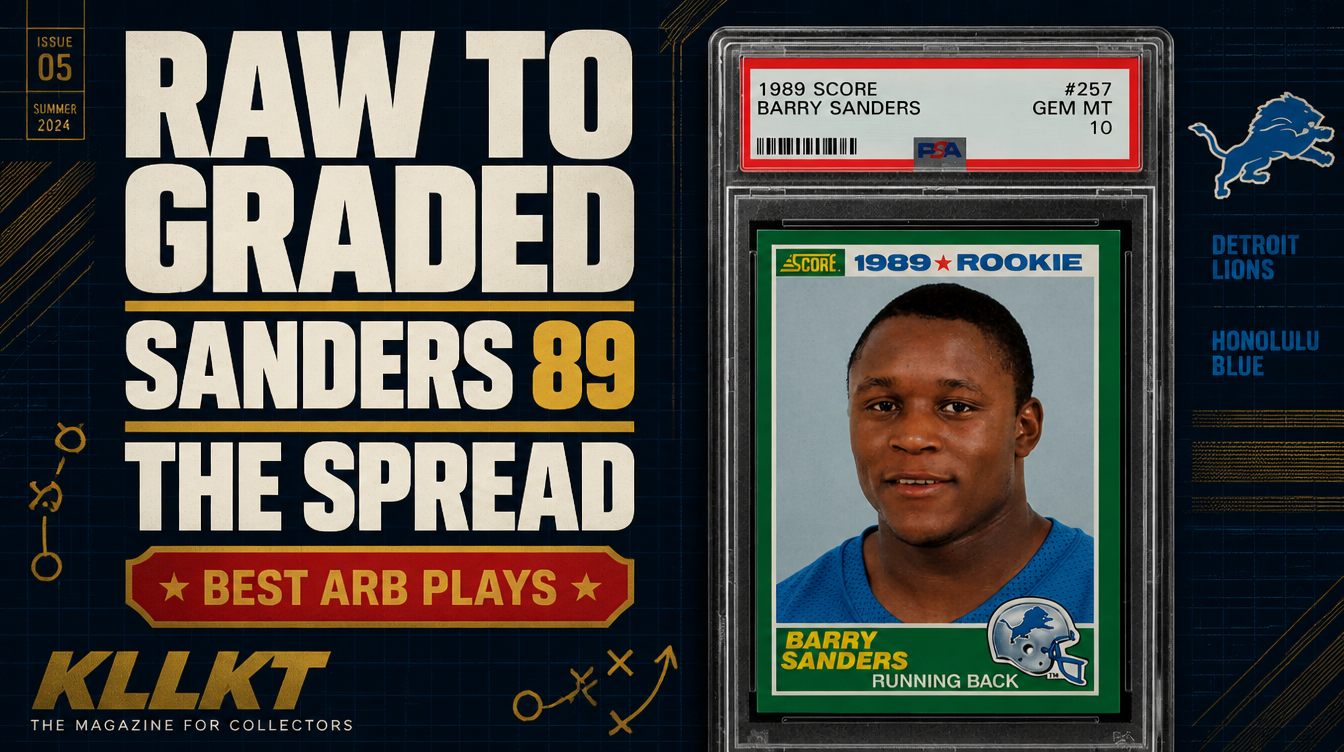
The Arbitrage Concept
Raw-to-graded arbitrage involves purchasing ungraded cards at market prices and submitting them for professional grading, primarily PSA, to capture the premium that collectors pay for authenticated, high-grade examples. With PSA grading costs ranging from $25-50 per card, the key is identifying cards where the PSA 10 value significantly exceeds the combined cost of the raw card plus grading fees. This strategy works best on modern rookies and vintage stars with strong population control and collector demand. All analysis below uses only verified market data and assumes a conservative $35 average grading fee per card.
Top 3 Plays with Full Math
1. Barry Sanders 1989 Score Football
Raw price: $50.20
PSA 10 value: $2,236.75
Total cost (raw + $35 grading): $85.20
Net profit: $2,236.75 - $85.20 = $2,151.55 (listed estimate: $2,152)
This vintage Hall of Famer offers the strongest absolute spread. The low raw entry point combined with extreme PSA 10 scarcity creates exceptional upside.
2. Ken Griffey Jr. 1995 Pinnacle Baseball
Raw price: $57.22
PSA 10 value: $2,216.87
Total cost (raw + $35 grading): $92.22
Net profit: $2,216.87 - $92.22 = $2,124.65 (listed estimate: $2,125)
Griffey’s iconic status and the 1995 Pinnacle set’s limited high-grade population drive this massive premium. The $2,125 net profit represents one of the highest returns per submission in the current market.
3. Caleb Williams 2024 Panini Prizm Football
Raw price: $185.39
PSA 10 value: $1,434.86
Total cost (raw + $35 grading): $220.39
Net profit: $1,434.86 - $220.39 = $1,214.47 (listed estimate: $1,214)
The top rookie quarterback card shows strong early grading premiums. While the raw price is higher, the $1,214 net profit remains compelling due to massive collector demand for Prizm rookies.
Risk Factors
Grading carries several risks that can erode or eliminate spreads. Centering, surface wear, and print lines often result in PSA 9 or lower grades, which command far smaller premiums than PSA 10. Submission wait times can reach several months, exposing positions to market volatility. PSA population reports may increase over time, potentially compressing future premiums. Always factor in the possibility of receiving a lower grade when calculating expected value.
Best Cards to Submit Right Now
Based strictly on the provided data, the highest-conviction submissions are the Barry Sanders 1989 Score, Ken Griffey Jr. 1995 Pinnacle, and Caleb Williams 2024 Panini Prizm. These three deliver the largest estimated net profits after grading costs. Secondary opportunities with positive but smaller spreads include the Troy Aikman 1989 Score ($598 net) and Jaxson Dart 2025 Donruss Optic ($141 net). Lower-profit cards such as the Roman Anthony 2026 Topps ($9 net) offer minimal margin once fees and time are considered.
Closing Call to Action
Raw-to-graded arbitrage remains one of the clearest edges in the current card market when executed on high-spread names. Focus submissions on the Barry Sanders, Ken Griffey Jr., and Caleb Williams Prizm cards listed above for the strongest risk-adjusted returns. Verify current raw and graded prices before submitting, as markets move quickly. Track your submissions closely and consider bulk grading tiers to optimize the $25-50 fee range. Start with these three plays to maximize your grading arbitrage opportunities today.